Guide to the SRSO-BISP Free Solar Scheme 2026: Claim Your Solar Home System Today
The SRSO-BISP Free Solar Scheme 2026 has emerged as a revolutionary step toward energy independence for the most vulnerable communities in Sindh. By tackling the dual challenges of extreme summer heatwaves and mounting electricity costs, the Government of Sindh has partnered with the World Bank and the Sindh Rural Support Organization (SRSO) to launch the Sindh Solar Energy Project (SSEP). Providing free, high-quality solar home systems to those registered under the Benazir Income Support Programme (BISP) is transforming lives in rural Sindh. For those seeking additional government-sector opportunities or public welfare updates, visiting SindhJobs.pk serves as a helpful resource for navigating various regional initiatives.
Understanding the SRSO-BISP Free Solar Scheme 2026 Objectives
The SRSO-BISP Free Solar Scheme 2026 aims to bridge the energy gap for thousands of households. Funded by a multi-million-dollar World Bank grant, this initiative relies on the extensive rural network of the SRSO to reach remote areas. The project is specifically tailored for families identified by the National Socio-Economic Registry (NSER) as living below the poverty line.
By solarizing these homes, the government effectively provides a shield against the volatile and high cost of traditional grid electricity, ensuring that light and basic cooling reach those who need it most. This proactive approach is expected to improve living standards significantly across the program’s reach.
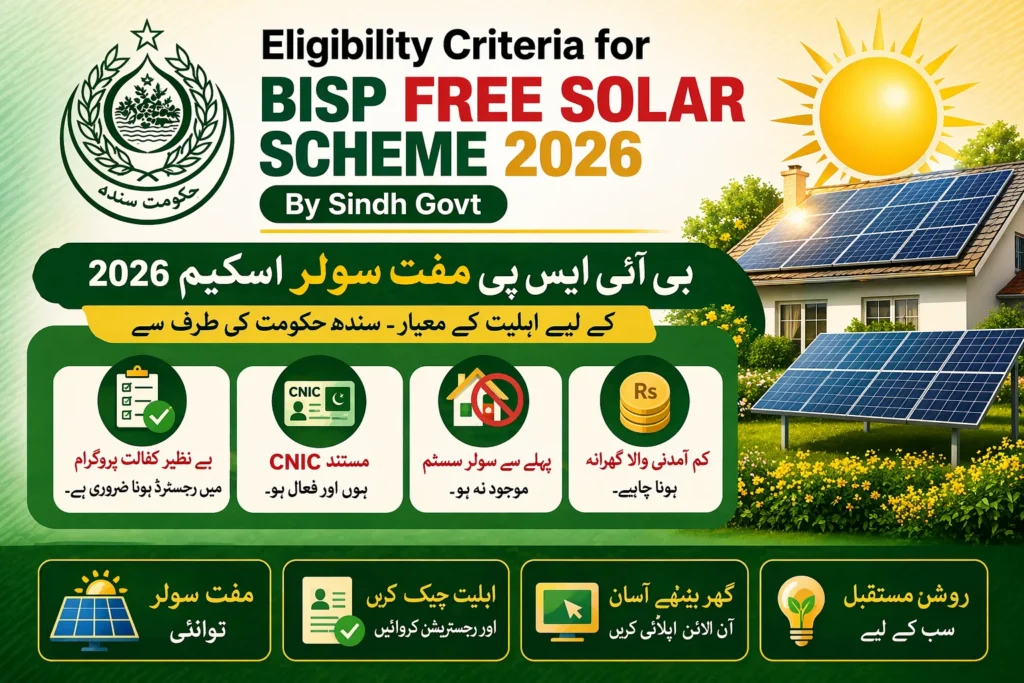
Eligibility Criteria for the SRSO-BISP Free Solar Scheme 2026
To qualify for the SRSO-BISP Free Solar Scheme 2026, applicants must fall under the criteria set by the Sindh Energy Department. Development experts often highlight that targeting the most impoverished districts is critical for long-term climate resilience. Priority is currently given to residents in flood-affected and high-poverty regions, specifically including districts such as Shikarpur, Khairpur, Jacobabad, Larkano, Kamber-Shahdadkot, and Kashmore.
Furthermore, candidates must be active BISP beneficiaries with a valid CNIC, and preference is given to households with low Poverty Means Test (PMT) scores and those residing in off-grid villages where traditional infrastructure remains absent. These targeted areas are vital for maximizing the impact of the initiative.
Prioritizing High-Risk Districts for the SRSO-BISP Free Solar Scheme 2026
The selection of districts for the SRSO-BISP Free Solar Scheme 2026 is a strategic decision based on vulnerability and need. Districts like Larkano and Jacobabad, often facing severe heat and water scarcity, are prime candidates for solar solutions. The Sindh government’s focus on these areas aims to provide immediate relief and long-term sustainability.
“Our aim is to bring equitable development and ensure that no community is left behind in the transition to clean energy,” stated a senior official from the Sindh Energy Department. “This scheme directly empowers those most affected by climate change and economic hardship.”
BISP Beneficiary Requirements for the SRSO-BISP Free Solar Scheme 2026
Active participation in the Benazir Income Support Programme (BISP) is a cornerstone of eligibility for the SRSO-BISP Free Solar Scheme 2026. Beneficiaries must possess a valid Computerized National Identity Card (CNIC) for verification purposes. The program builds upon existing social safety nets to ensure that aid reaches the intended recipients efficiently.
Many residents in rural Sindh rely on BISP for essential support, making this a natural pathway for solar adoption. The program leverages this established network to streamline the registration and distribution process.
What is Inside the SRSO-BISP Free Solar Scheme 2026 Kit?
The SRSO-BISP Free Solar Scheme 2026 provides hardware that adheres to strict international standards to ensure longevity in the harsh Sindh climate. Unlike cheaper market alternatives, these kits are engineered for high performance. Each “Power Pack” typically includes a high-efficiency solar panel treated for extreme heat, a durable deep-cycle battery for overnight storage, and a professional-grade charge controller.
Additionally, recipients receive energy-efficient DC fans, LED lights for safe indoor illumination, and dedicated mobile charging ports. If you are looking for more information on development projects or career-related updates, be sure to check SindhJobs.pk for periodic insights. The inclusion of these components ensures a comprehensive solution for basic household energy needs.
High-Efficiency Solar Panels in the SRSO-BISP Free Solar Scheme 2026
The solar panels provided through the SRSO-BISP Free Solar Scheme 2026 are designed to withstand extreme temperatures. Their high efficiency means they can generate more electricity even under intense sunlight, a common occurrence in Sindh. This ensures maximum power output throughout the day.
The durability of these panels is crucial for the scheme’s long-term success, minimizing the need for frequent replacements and maintenance in remote areas. This technical specification is vital for the project’s sustainability.
Essential Components of the Solar Home System for SRSO-BISP Free Solar Scheme 2026
Beyond the solar panel, the kit for the SRSO-BISP Free Solar Scheme 2026 includes a robust battery to store energy for use after sunset. A charge controller regulates the flow of electricity, protecting the battery from overcharging or deep discharge, thereby extending its lifespan.
The inclusion of LED lights offers a safe and energy-efficient alternative to traditional lighting methods, while the DC fans provide much-needed cooling during sweltering summers. The mobile charging ports also connect households to the outside world.
How to Register for the SRSO-BISP Free Solar Scheme 2026
The application process for the SRSO-BISP Free Solar Scheme 2026 is built on transparency to eliminate corruption. First, applicants should confirm their status by messaging their CNIC to 8171. Once confirmed, they must visit their local Local Support Organization (LSO) office to request the official verification form.
Essential documents include your original CNIC, your BISP benefit proof, and a current photograph of your home. Following submission, an SRSO field officer will conduct a physical inspection to confirm the household’s specific needs and installation logistics. This multi-step process ensures that only eligible and deserving households benefit from the scheme.
Step-by-Step Verification for the SRSO-BISP Free Solar Scheme 2026
The initial step for potential beneficiaries of the SRSO-BISP Free Solar Scheme 2026 involves SMS verification. Sending your CNIC number to 8171 confirms your eligibility through the BISP database. This digital gateway is the first hurdle to overcome.
Following this confirmation, the focus shifts to physical presence and documentation at the local LSO. This human touch ensures that all necessary paperwork is correctly submitted and that the applicant’s circumstances are understood firsthand.
Documentation and Site Inspection in the SRSO-BISP Free Solar Scheme 2026 Registration
Gathering the correct documents is crucial for successful registration in the SRSO-BISP Free Solar Scheme 2026. The CNIC acts as the primary identification, while BISP proof solidifies program allegiance. A home photograph provides visual evidence of the living conditions.
The subsequent physical inspection by an SRSO officer is perhaps the most critical stage. This verifies the presence of eligible residents, assesses the suitability of the home for solar panel installation, and confirms the real-time needs of the household, thereby preventing fraudulent applications.
Socio-Economic Impact of the SRSO-BISP Free Solar Scheme 2026
The SRSO-BISP Free Solar Scheme 2026 is fundamentally shifting the economic landscape of rural households. Officials have noted that by eliminating electricity bills, families can redirect their limited income toward nutrition and education. Beyond finances, the project offers significant health benefits by replacing hazardous kerosene lamps, which often cause respiratory ailments, with clean LED light.
Furthermore, the registration process empowers women, as the solar system is documented in the female household head’s name, strengthening her decision-making role within the family. This empowerment extends beyond energy access, fostering greater gender equality.
Economic Relief Through the SRSO-BISP Free Solar Scheme 2026
For families previously burdened by rising electricity tariffs, the SRSO-BISP Free Solar Scheme 2026 represents significant economic relief. Anecdotal evidence from early beneficiaries suggests that the money saved on electricity bills is being reinvested in children’s education and improved diets. This fiscal freedom is a powerful driver of upward mobility.
The World Bank has projected substantial savings for participating households, contributing to local economic multipliers. Access to reliable, free energy reduces operational costs for small home-based businesses as well.
Health and Empowerment Benefits of the SRSO-BISP Free Solar Scheme 2026
The transition to solar power facilitated by the SRSO-BISP Free Solar Scheme 2026 brings immediate health improvements. Indoor air quality dramatically improves with the elimination of kerosene lamps, reducing the incidence of respiratory illnesses. Brighter, safer LED lighting also enhances study conditions for children.
Moreover, by prioritizing female household heads in the registration process, the scheme enhances their status and autonomy. This gender-sensitive approach is designed to foster more equitable household management and decision-making.
Frequently Asked Questions about the SRSO-BISP Free Solar Scheme 2026
Q1: Who is eligible for the SRSO-BISP Free Solar Scheme 2026?
A1: Eligibility is primarily for active Benazir Income Support Programme (BISP) beneficiaries residing in specific high-poverty and flood-affected districts of Sindh. A valid CNIC and a low Poverty Means Test (PMT) score are also required.
Q2: What is included in the SRSO-BISP Free Solar Scheme 2026 kit?
A2: Each kit typically contains a high-efficiency solar panel, a deep-cycle battery, a charge controller, energy-efficient LED lights, DC fans, and mobile charging ports.
Q3: How do I register for the SRSO-BISP Free Solar Scheme 2026?
A3: You must first text your CNIC to 8171 to confirm your BISP status. Then, visit your local Local Support Organization (LSO) office with your CNIC, BISP proof, and a home photograph to complete the application and verification process.
Q4: Are there any costs associated with the SRSO-BISP Free Solar Scheme 2026?
A4: The scheme is entirely free for eligible beneficiaries. The hardware and installation are covered by the Sindh Solar Energy Project, funded by the World Bank.
Q5: What happens after I submit my application for the SRSO-BISP Free Solar Scheme 2026?
A5: After submitting your documents, an SRSO field officer will conduct a physical inspection of your household to verify your needs and assess installation feasibility. Successful applicants will then be scheduled for installation.
Q6: Can I apply if I am not currently a BISP beneficiary?
A6: No, active BISP beneficiary status is a mandatory requirement for applying to the SRSO-BISP Free Solar Scheme 2026.
Q7: What if my district is not mentioned in the priority list for the SRSO-BISP Free Solar Scheme 2026?
A7: The scheme initially prioritizes specific districts due to their higher vulnerability. However, future phases may expand to include other districts. It is advisable to stay updated through official channels.
Conclusion
The SRSO-BISP Free Solar Scheme 2026 represents a significant leap forward in the Government of Sindh’s commitment to improving the lives of its most vulnerable citizens. By providing free solar home systems, the initiative not only combats the immediate challenges of high energy costs and extreme weather but also fosters long-term economic stability, health benefits, and gender empowerment. The successful implementation, spearheaded by the SRSO in partnership with BISP and the World Bank, sets a precedent for sustainable development in rural Pakistan, offering a tangible pathway to a brighter, more energy-independent future for thousands of households. The program’s meticulously planned registration and distribution process, focusing on transparency and need, ensures that these solar solutions reach those who will benefit most.