Sindh Govt Free BISP Solar Scheme 2026 Online Registration Guide Available Now
The SRSO-BISP Free Solar Scheme 2026 has emerged as a revolutionary step toward energy independence for the most vulnerable communities in Sindh. By tackling the dual challenges of extreme summer heatwaves and mounting electricity costs, the Government of Sindh has partnered with the World Bank and the Sindh Rural Support Organization (SRSO) to launch the Sindh Solar Energy Project (SSEP). This initiative is designed to provide sustainable energy solutions to those who need them most across the province.
Providing free, high-quality solar home systems through the SRSO-BISP Free Solar Scheme 2026 is transforming lives in rural Sindh. Families identified as living below the poverty line now have access to reliable electricity without the burden of monthly bills. For those seeking additional government-sector opportunities or public welfare updates, visiting SindhJobs.pk serves as a helpful resource for navigating various regional initiatives.
Understanding the SRSO-BISP Free Solar Scheme 2026 Objectives
The SRSO-BISP Free Solar Scheme 2026 aims to bridge the energy gap for thousands of households that have historically remained off the grid. Funded by a multi-million-dollar World Bank grant, this initiative relies on the extensive rural network of the SRSO to reach the most remote areas. The government’s goal is to ensure that geography is no longer a barrier to reliable and clean energy.
This specific project is uniquely tailored for families identified by the National Socio-Economic Registry (NSER) as living below the poverty line. By solarizing these homes through the SRSO-BISP Free Solar Scheme 2026, the government effectively provides a shield against the volatile and high cost of traditional grid electricity. This targeted approach ensures that basic cooling and lighting reach the most marginalized segments of society first.
Eligibility Criteria for the SRSO-BISP Free Solar Scheme 2026
To qualify for the SRSO-BISP Free Solar Scheme 2026, applicants must fall under the strict criteria set by the Sindh Energy Department. Development experts often highlight that targeting the most impoverished districts is critical for long-term climate resilience. Priority is currently given to residents in flood-affected and high-poverty regions where infrastructure was severely damaged in recent years.
Current regional priorities for the SRSO-BISP Free Solar Scheme 2026 include residents in districts such as Shikarpur, Khairpur, Jacobabad, Larkano, Kamber-Shahdadkot, and Kashmore. Furthermore, candidates must be active BISP beneficiaries with a valid CNIC. Preference is strictly given to households with low Poverty Means Test (PMT) scores and those residing in off-grid villages where traditional infrastructure remains entirely absent.
What is Inside the SRSO-BISP Free Solar Scheme 2026 Kit?
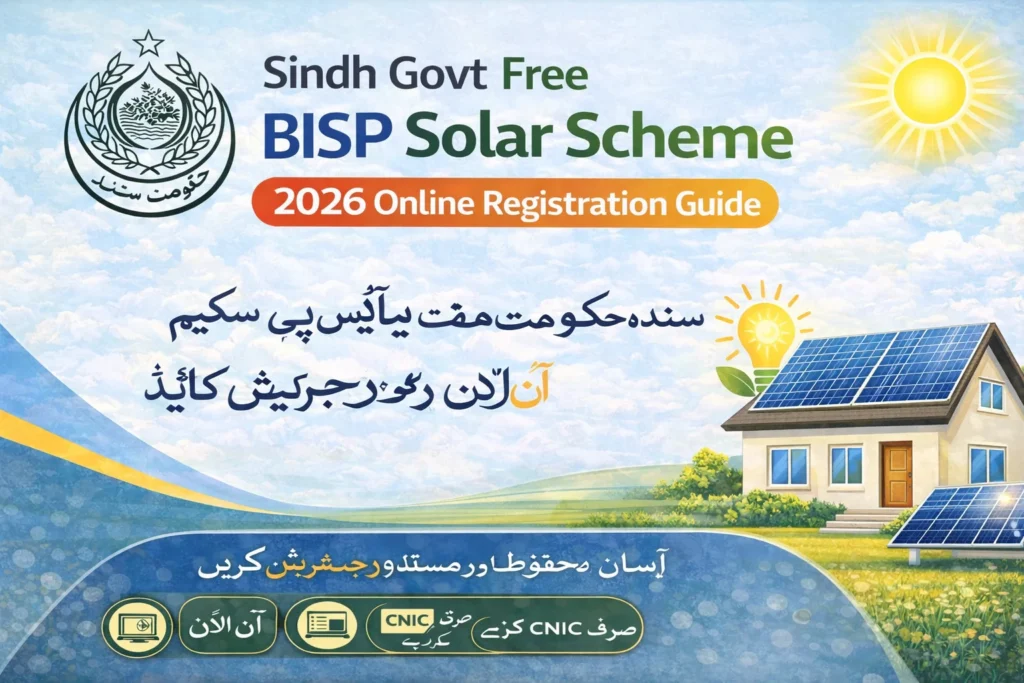
The SRSO-BISP Free Solar Scheme 2026 provides hardware that adheres to strict international standards to ensure longevity in the harsh Sindh climate. Unlike cheaper market alternatives that fail in high temperatures, these kits are engineered for high performance and durability. Each system is designed to provide enough power for essential household needs, reducing the reliance on flammable fuels.
Each “Power Pack” distributed under the SRSO-BISP Free Solar Scheme 2026 typically includes a high-efficiency solar panel treated for extreme heat and a durable deep-cycle battery for overnight storage. Additionally, recipients receive energy-efficient DC fans, LED lights for safe indoor illumination, and dedicated mobile charging ports. If you are looking for more information on development projects or updates, be sure to check SindhJobs.pk for periodic insights.
How to Register for the SRSO-BISP Free Solar Scheme 2026
The application process for the SRSO-BISP Free Solar Scheme 2026 is built on transparency to eliminate corruption and ensure the equipment reaches the rightful owners. First, potential applicants should confirm their current status by messaging their CNIC to the 8171 helpline. Only those confirmed as active beneficiaries can move to the next physical step of the application process.
Once confirmed for the SRSO-BISP Free Solar Scheme 2026, residents must visit their local Local Support Organization (LSO) office to request official forms. Essential documents include your original CNIC, BISP benefit proof, and a current photograph of your home. Following submission, an SRSO field officer will conduct a physical inspection to confirm existing needs and check if the home is fit for solar installation.
Socio-Economic Impact of the SRSO-BISP Free Solar Scheme 2026
The SRSO-BISP Free Solar Scheme 2026 is fundamentally shifting the economic landscape of rural households by providing free energy. Officials have noted that by eliminating electricity bills, families can redirect their limited income toward nutrition, medicine, and education. This shift creates a ripple effect that benefits the local economy as disposable income increases within these communities.
Beyond finances, the SRSO-BISP Free Solar Scheme 2026 offers significant health benefits by replacing hazardous kerosene lamps with clean LED light. Kerosene lamps are known to cause respiratory ailments, which disproportionately affect children and the elderly. Furthermore, the registration process empowers women, as the solar system is documented in the female household head’s name, strengthening her decision-making role within the household.
FAQs About the SRSO-BISP Free Solar Scheme 2026
1. Who is eligible for the SRSO-BISP Free Solar Scheme 2026?
Active BISP beneficiaries with a valid CNIC residing in priority districts like Shikarpur and Khairpur are eligible. Priority is given to those in off-grid areas with low PMT scores.
2. Is there a fee for applying to the SRSO-BISP Free Solar Scheme 2026?
No, the schemes provided under this initiative are entirely free for eligible candidates as they are funded by the Government of Sindh and the World Bank.
3. What happens if the SRSO-BISP Free Solar Scheme 2026 equipment breaks?
Recipients are usually provided with a contact number for their regional SRSO support center. Standard components often come with limited warranties handled through the solar suppliers.
4. Can town residents apply for the SRSO-BISP Free Solar Scheme 2026?
Currently, the program prioritizes off-grid and rural villages where grid electricity is non-existent or unreliable. Urban eligibility depends on future project expansions.
5. How long does the SRSO-BISP Free Solar Scheme 2026 installation take?
After verification and physical inspection, installation typically occurs within a few weeks, depending on the availability of hardware packages in that district.
Conclusion
The SRSO-BISP Free Solar Scheme 2026 stands as a beacon of hope for many families struggling with energy poverty in Sindh. By combining the financial strength of the World Bank with the operational expertise of the SRSO, the project has ensured that clean, sustainable energy is accessible to the most vulnerable citizens. This initiative not only reduces the financial burden on the poor but also paves the way for a more climate-resilient province. As households across rural districts light up for the first time, the socio-economic empowerment generated by this scheme will likely be felt for generations, marking a significant milestone in Sindh’s development history.