Sindh Govt Livestock Scheme 2026: Empowering Rural Families with Sustainable Livelihoods
The Sindh Govt Livestock Scheme 2026 represents a significant step forward in the province’s strategy to combat poverty and uplift rural communities. This vital initiative aims to provide underprivileged families with a sustainable source of income and improved nutrition by distributing free milk-producing animals such as cows and buffaloes. Announced by Sindh Chief Minister Murad Ali Shah, the program moves beyond one-time financial aid, focusing instead on empowering households to build a long-term dairy business.
This comprehensive scheme is designed to transform the economic landscape of rural Sindh. By providing productive assets, the government ensures that beneficiary families can generate regular income through milk sales, fostering independence. The focus on livestock distribution addresses multiple aspects of poverty, from income generation to nutritional improvement, especially for children.
Understanding the Sindh Govt Livestock Scheme 2026’s Core Purpose
The core purpose of the Sindh Govt Livestock Scheme 2026 is to create enduring economic opportunities for the most vulnerable. Instead of offering temporary relief, this initiative equips families with valuable assets that can grow over time. A healthy cow or buffalo can produce approximately 8 to 15 liters of milk daily, providing a consistent product for sale in local markets and ensuring a steady flow of income for the household.
Beyond individual family benefits, the program contributes to broader socio-economic goals. It is designed to significantly reduce rural poverty, enhance nutrition levels, particularly for children, and empower women by involving them in managing the livestock and controlling the dairy income. Furthermore, it actively encourages and supports the development of small-scale dairy farming across Sindh.
Key Details of the Sindh Livestock Scheme
The Sindh Livestock Scheme 2026 is a meticulously planned initiative by the provincial government. It falls under the purview of the Sindh Livestock & Fisheries Department, which is tasked with its implementation and oversight. The primary benefit for eligible families includes the provision of a free milk-giving animal, either a cow or a buffalo, depending on availability and regional suitability.
The program specifically targets poor families, including widows and landless farmers, who reside in rural areas and are capable of managing livestock. The application process is streamlined through District Livestock Offices and government registration desks, ensuring accessibility for all deserving applicants. Information regarding similar government initiatives can often be found on platforms like SindhJobs.pk.
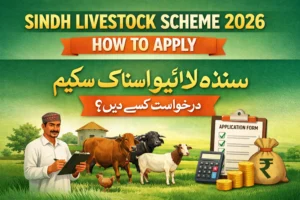
Eligibility Criteria for the Sindh Govt Livestock Scheme
To ensure that the benefits of the Sindh Govt Livestock Scheme 2026 reach those who need them most, strict eligibility criteria have been established. Applicants must be permanent residents of Sindh and possess a valid Computerized National Identity Card (CNIC). A crucial requirement is a low poverty score registered in the National Socio-Economic Registry (NSER) or Poverty Score Card (PSER) databases.
Special preference will be given to certain vulnerable groups, including widows, female-headed households, persons with disabilities, and landless farmers living in rural areas. Families already receiving assistance under the Benazir Kafalat Program will also be prioritized, leveraging existing welfare databases for efficient targeting. All poverty data verification is closely linked with records from the National Database and Registration Authority (NADRA) and government welfare programs.
Essential Documents for the Sindh Govt Livestock Scheme Application
Prospective applicants for the Sindh Govt Livestock Scheme 2026 must prepare a set of essential documents to facilitate a smooth application process. These include the original CNIC, Sindh Domicile, and PRC Form-D, which confirm residency. A Family Registration Certificate (FRC) is also required to verify household composition.
Furthermore, applicants should provide proof of income or their Benazir Income Support Program (BISP) card, if applicable, to substantiate their financial need. Two recent passport-size photographs are also necessary. Ensuring all documentation is complete and accurate will help avoid unnecessary delays during the verification stages of this vital initiative.
Step-by-Step Application for the Sindh Govt Livestock Scheme
Applying for the Sindh Govt Livestock Scheme 2026 involves a clear, step-by-step process designed for transparency and efficiency. The first crucial step is to update your household information in the NSER or PSER database, as this is the primary mechanism for identifying eligible families. This ensures your poverty score is current and accurate.
Next, applicants should visit their nearest District Livestock Office of the Sindh Livestock & Fisheries Department. Here, they can request and meticulously fill out the official application form, providing details on household size, monthly income, and livelihood information. Once completed, the form, along with all required documents, must be submitted to the authorized officer. Following this, government officials may conduct a home verification survey to confirm living conditions. Finally, if applications exceed available animals, a transparent balloting system will be conducted, with selected applicants receiving confirmation via SMS or official lists.
Long-Term Benefits of the Sindh Govt Livestock Scheme
The Sindh Govt Livestock Scheme 2026 offers a multitude of long-term advantages that extend far beyond initial asset provision. Foremost among these is the establishment of a stable income source for families. By selling fresh milk daily, households can earn regular cash, improving their financial stability. This consistent income allows families to invest in other necessities and improve their quality of life.
Another significant benefit is improved nutrition. Children, in particular, gain access to fresh milk and dairy products, which are crucial for their growth and development. The scheme also fosters asset growth, as animals can reproduce, thereby increasing a family’s livestock wealth over time. Crucially, the program promotes women’s empowerment, as women in many rural areas traditionally manage livestock and often gain control over the dairy income, enhancing their financial participation and independence.
Frequently Asked Questions about the Sindh Govt Livestock Scheme
1. Is the livestock provided completely free under the Sindh Govt Livestock Scheme 2026?
Yes, the animals are given free of cost as a government grant to deserving families.
2. Can applicants choose between a cow or a buffalo?
Usually, the government decides based on livestock availability and regional climate conditions to ensure suitability and sustainability.
3. When will the application deadline for the Sindh Livestock Scheme 2026 be announced?
District-wise deadlines will be announced through local newspapers and official government channels, including the Sindh government portal.
4. What if my household information is not updated in NSER or PSER?
It is crucial to update your household information in these databases as they are used to identify and verify eligible families for the scheme.
5. How will selected applicants be notified?
Selected applicants will typically receive confirmation through SMS or their names will be published on official lists by the Sindh Livestock & Fisheries Department.
6. Is there any training provided for beneficiaries on managing livestock?
While not explicitly stated in the initial announcement, such schemes often include basic training or guidance on animal care and dairy management. Applicants should inquire at their District Livestock Office.
Conclusion
The Sindh Govt Livestock Scheme 2026 stands as a testament to the provincial government’s commitment to sustainable poverty alleviation. By providing productive assets like milk-producing cows and buffaloes, the initiative empowers low-income families across Sindh to secure a long-term, stable income through dairy farming. This strategy not only improves economic standing but also enhances nutritional outcomes and promotes women’s financial independence in rural areas. For families grappling with poverty, this scheme offers a tangible pathway to self-sufficiency, transforming lives and contributing to the overall development of the province. Applicants are encouraged to stay informed through official government channels and local news to seize this life-changing opportunity.