A Guide to Joining the Pakistan Military Academy: The 158 PMA Long Course
The Pakistan Military Academy (PMA) Long Course represents the primary entry point for young individuals aspiring to become commissioned officers in the Pakistan Army. The 158 PMA Long Course is the latest opportunity for candidates to undergo rigorous training and begin a career dedicated to national service and leadership development. The recruitment drive for the 158 PMA Long Course was recently announced, inviting eligible candidates from across Pakistan to participate in the selection process. This highly selective program emphasizes physical fitness, academic knowledge, and leadership potential, serving as a gateway to professional advancement within the armed forces.
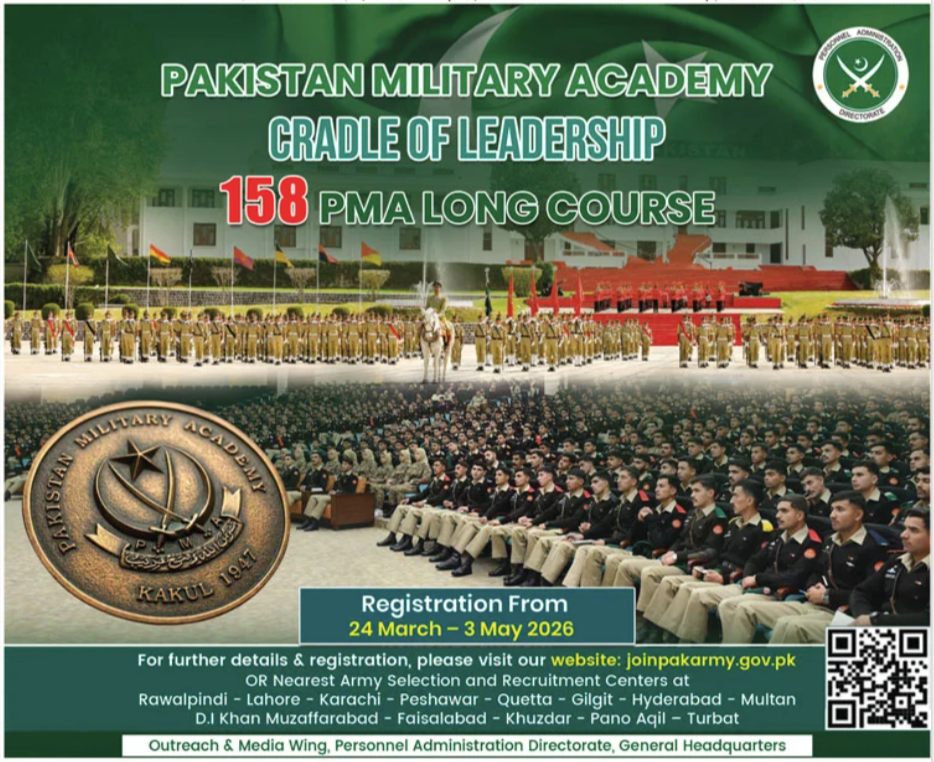
The 158 PMA Long Course, as advertised on March 24, 2026, in daily Jang Newspaper, marks a critical opportunity for aspirants to contribute to the nation’s defense infrastructure. The recruitment process is structured to identify individuals who are not only physically capable but also mentally agile and ethically sound. The selected candidates will undergo an intensive two-year training period at the Pakistan Military Academy in Kakul, Abbottabad, before formally joining the ranks as commissioned second lieutenants.
Eligibility Requirements for the 158 PMA Long Course
Candidates seeking to join the Pakistan Military Academy (PMA) must meet specific preliminary criteria before engaging in the selection process for the 158 PMA Long Course. These requirements cover educational qualifications, physical standards, and age limitations, ensuring that only the most suitable individuals are considered for officer training.
To be eligible, candidates must generally hold an Intermediate (FA/FSc or equivalent A-Level) qualification. While the advertisement mentioned “Matric etc.” as preferred education, a high school diploma or equivalent is typically required for higher-level applications. Candidates must have achieved at least a 60-65% score in their Intermediate examination. Age requirements usually range from 17 to 22 years for non-serving candidates, with some relaxation provided for individuals who have acquired a bachelor’s degree or are serving in the armed forces. Physical standards include a minimum height of 5 feet 4 inches (162.5 cm) for male applicants, along with standards for weight and vision, which are strictly measured during medical screening.
Understanding the Online Application Process
The Pakistan Army facilitates a comprehensive online application process for the 158 PMA Long Course. Interested candidates must register online on the official website, usually accessible immediately after the advertisement publication date. This system streamlines the initial process and allows candidates to register for preliminary tests at their preferred centers.
The application period for the 158 PMA Long Course typically spans several weeks, with the registration window for the recent cycle closing on May 3, 2026. Applicants are advised to carefully review all instructions provided in the advertising material. The process includes completing an online form with personal details, educational history, and selecting a preliminary test location. Candidates are also advised to check specific job boards and information portals, such as SindhJobs.pk, for details regarding preliminary test schedules and application deadlines, as these sources complement the official announcements.
The Selection Procedure for Pakistan Military Academy Cadets
The selection process for the 158 PMA Long Course is known for its rigor and multi-stage approach. It is designed to evaluate candidates on various parameters, including academic knowledge, physical attributes, psychological suitability, and leadership potential.
Initial Written Tests and Physical Assessments
The initial stage involves a computer-based test conducted at designated recruitment centers across major cities including Rawalpindi, Peshawar, Lahore, Karachi, and Quetta. This test typically comprises three sections: verbal intelligence, non-verbal intelligence, and general knowledge/academic content related to Intermediate subjects. Candidates who achieve qualifying marks in this test proceed to the physical endurance portion of the selection process. Failure in either the written or physical assessment results in elimination.
Physical assessments for the 158 PMA Long Course require candidates to meet minimum standards in running, push-ups, sit-ups, and chin-ups within specific timeframes. Successful completion demonstrates the requisite physical fitness required for the subsequent training phase.
Medical Examination and Final Interview
Following the initial assessments, shortlisted candidates undergo a comprehensive medical examination by military doctors at the recruitment centers (e.g., in Rawalpindi, Multan, or Hyderabad). This screening ensures candidates are physically capable of handling the demanding environment of military training and service.
The final stage involves an interview by an Inter Services Selection Board (ISSB). This rigorous interview process evaluates the candidate’s character, leadership qualities, psychological profile, and suitability for command. The selection board assesses confidence, communication skills, and personal integrity before finalizing candidates for the 158 PMA Long Course.
Training and Career Trajectory
Successful candidates for the 158 PMA Long Course will undergo a two-year training regime at the Pakistan Military Academy, where they focus on military tactics, academic studies, physical fitness, and leadership development. Upon graduation and successful completion of the training, cadets are awarded a degree in engineering, social sciences, or humanities by the Pakistan Army and commission as Second Lieutenants. This commissioning marks the beginning of a fulfilling career in the Pakistan Army, with opportunities for promotion through various ranks, specialized training, and deployments both nationally and internationally.
FAQs on the 158 PMA Long Course
1. What is the minimum educational requirement for the 158 PMA Long Course?
The standard requirement is an Intermediate degree (FA/FSc or equivalent A-Levels) with a minimum percentage (usually 60-65%). Candidates with a Matric qualification may apply during their Intermediate studies, subject to specific guidelines outlined in the advertisement.
2. Where are the testing centers located for the 158 PMA Long Course?
Preliminary testing centers are typically established in major cities across multiple provinces, including Rawalpindi, Peshawar, Lahore, Gilgit, Turbat, Karachi, Hyderabad, Pano Aqil, Multan, Dera Ismail Khan, Khuzdar, Quetta and Faisalabad.
3. What is the process after the initial application for the 158 PMA Long Course?
Initial applications are followed by computerized written tests, physical assessments, medical examinations, and interviews conducted by the Inter Services Selection Board (ISSB) before final selection.
4. Can females apply for the 158 PMA Long Course?
The PMA Long Course is specifically designed for male candidates. Females can apply for commissioning in the Pakistan Army through separate programs, such as specific technical corps or women’s short service courses, depending on educational background and available advertisements.
5. How long is the training period for the 158 PMA Long Course?
The training period at the Pakistan Military Academy lasts for two years.
6. What is the age limit for application?
For non-serving candidates, the age range is typically between 17 and 22 years, with specific rules for ex-servicemen or candidates with higher education.
Conclusion
The 158 PMA Long Course presents a significant opportunity for young Pakistanis to pursue a career of service and leadership. As the application window closed on May 3, 2026, the selection process is now underway to identify the next generation of officers for the Pakistan Army. This demanding journey, starting from initial registration to final selection by the ISSB, reflects the high standards required for entry into the military academy. Successful candidates will not only gain a professional career but also a unique opportunity to lead and serve the nation in one of its most prestigious institutions.